
Tired of losing value on your collections and Pokémon card purchases? Fed up with sending cards to PSA, PCA, Collect Aura... only to get 6, 7 or 8 grades back? Do you have binders full of cards and don't know which ones should be graded ? That ends today. Here are four tips for choosing which cards to grade to get the most out of your collectible cards.
1. CARD CONDITION
The card's condition is paramount. Many people focus only on the overall look of the card, especially the centering. However, it's crucial to examine the corners and edges.

- Centering : Centering refers to the alignment of the card's image relative to its borders. A well-centered card has equal borders on each side. Poor centering, where the image is shifted to one side, can lower the grade of the card even if the rest is in perfect condition. To check centering, you can use specific tools available on the market or simply compare the borders on each side of the image visually.
- Corners : The card's corners should be sharp, not scuffed or rounded. Damaged corners are often a sign that the card has been handled or stored incorrectly, which can seriously affect the final grade. We talked about this in our previous blog post on the best ways to store your trading cards. Corners are often the first part of a card to show wear, so pay special attention when examining them.
- Edges : The card's edges should be smooth and free of any scuffs or discoloration. Scuffed edges can happen when cards are inserted into or removed from their sleeves, or rubbed against other hard surfaces. Make sure the card's edges are as intact as possible before considering grading.
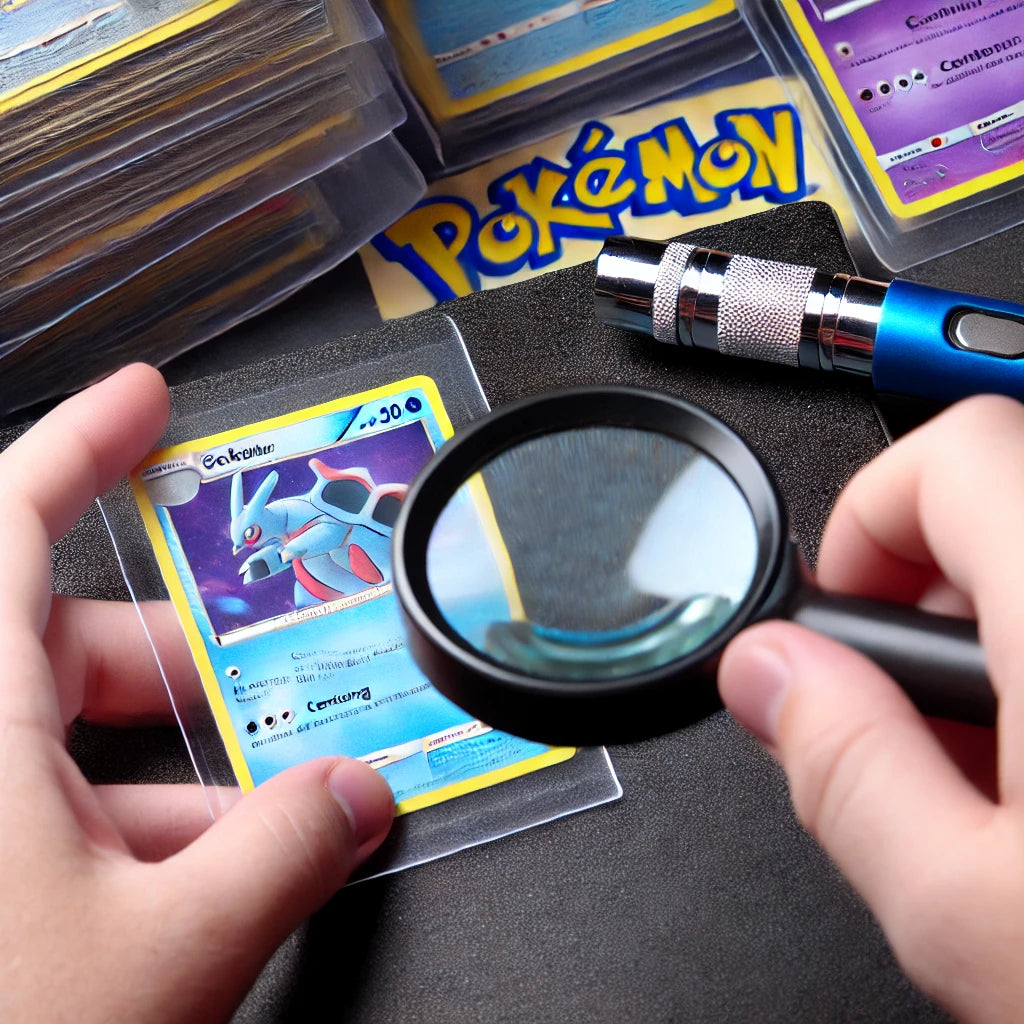
Using a magnifying glass or a black light can reveal imperfections invisible to the naked eye. If a card shows visible damage, it's better to keep it in a binder rather than have it graded.
2. CARD SURFACE
Besides edges and corners, the card's surface must be flawless. Scratches or dents can severely affect the final grade. Again, a magnifying glass can help spot these imperfections. Grading services like PSA (an American company) or PCA (a French company) take the condition of the card surface very seriously.
A perfect surface is essential for a high grade. Sometimes cards that look perfect to the naked eye can have scratches or minor dents that are only visible with a black light or specific lighting. Be sure to check each card under different lighting angles to spot these potential defects.

3. PRICE TRENDS
Before deciding to grade a card, it's important to check price trends. Use online resources like Cardmarket to see whether the card's price is rising, falling or stable. This will help you decide whether it's worth investing in grading that card.
Price trends can fluctuate depending on various factors, such as the card's popularity, market conditions and special events. For example, a card whose price tends to rise may be a good candidate for grading, while a card whose value is falling might not be worth the investment.
4. GRADING PROBABILITY AND POPULATION REPORTS FROM GRADING COMPANIES
Check the grading probability report and the population report from grading companies — we like what PokeTracker does on Instagram and on its site. This means looking at how many similar cards have been graded and what grades they got. For example, if a card has a high probability of getting a 9 or 10, it may be worth the investment. On the other hand, if the probability is low, it may be better not to take the risk.

Grading probability can be determined by looking at the population report from PSA for a specific card. For example, if a card has a 76% rate for a grade of 10, that indicates a strong chance of a high grade. Using these reports to assess your cards can help you make informed decisions about which ones to grade to maximize your return on investment.
Conclusion
To maximize the value of your Pokémon cards, it's essential to follow these four tips: check the overall condition and surface of the card, track price trends and look at grading probability reports. By taking these factors into account, you can make informed choices and increase your chances of getting a return on your Pokémon card investments.
For more details and tips on grading Pokémon cards, be sure to follow our account Instagram and upcoming articles. Use the tools available and do your homework to make sure every grading decision is based on solid information and thorough analysis.